
A list of curiosities about marriage in Italy between rites, customs and tradition
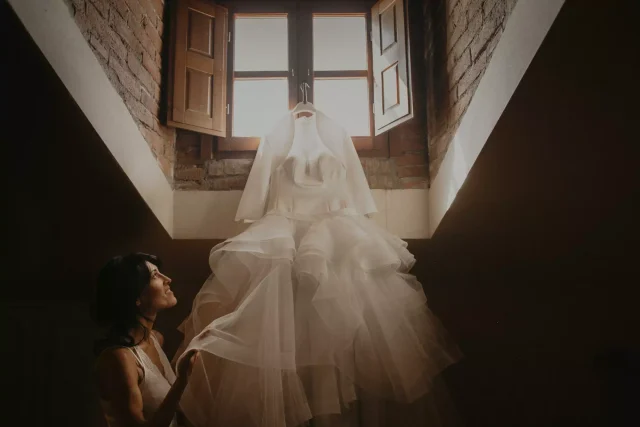
We often say that we are not superstitious, but when it comes to weddings it is also right to take into consideration rites, customs and traditions of our country. A wedding must be perfect from A to Z, perhaps with the help of a wedding planner, and therefore nothing should be left to chance. Your most beautiful day shouldn't make a crease, just like the dress you'll wear.
Let's see together a series of curiosity about wedding in Italy, exploring the tradition and all those customs related to this magical event in our lives, despite the fact that today we are a little less superstitious than we used to be.
Wedding preparations
Wedding preparations also follow a series of customs which involve assigning tasks to certain members of the family. As the older generations have taught us, the bride's mother must make the trousseau (bed linen, towels, tablecloths, etc.), while the mother-in-law takes care of the appliances and household items such as crockery, pots and the like. In a nutshell, to each his own, just as tradition dictates.
As far as wedding rings are concerned, etiquette requires the groom to take care of them. In fact, today they are a gift from witnesses. Tradition requires that they are kept until the wedding day by whoever bought them. More and more frequently they are carried to the altar by pageboys.
An auspicious day of the week
How to choose your wedding day? Tradition provides all the indications to avoid nasty surprises.
The first rule is the one recited by a famous popular proverb, “Neither of Venus nor of Mars, neither marries nor leaves”. I'd say it's pretty clear: the first because it's the day evil spirits were created and the second because it refers to Mars, god of war.
But what about the other days of the week instead? The most favorable days would seem to be Monday, which brings good health, and Wednesday. The days to be avoided absolutely are Thursday, a vehicle of displeasure for the bride, Friday and Saturday, the most unfortunate of all but also the most popular.
Rites and traditions of the bride
The bride is certainly the one who has more rites to observe and know, starting from the dress up to the garter.
Indeed, it is said that the bride must wear five auspicious objects: something blue (purity), old (one's past), new (the future), given (love for close people) and loaned (the bond with family).
To really complete, I'd also add something red. The association of this color to weddings probably has ancient origins, just think that the noble patrician ladies of ancient Rome, brides in the Middle Ages and women in the Byzantine era wore red. Red is a symbol of love, passion and fruitfulness. Simply put, the perfect recipe for a long and lasting marriage.
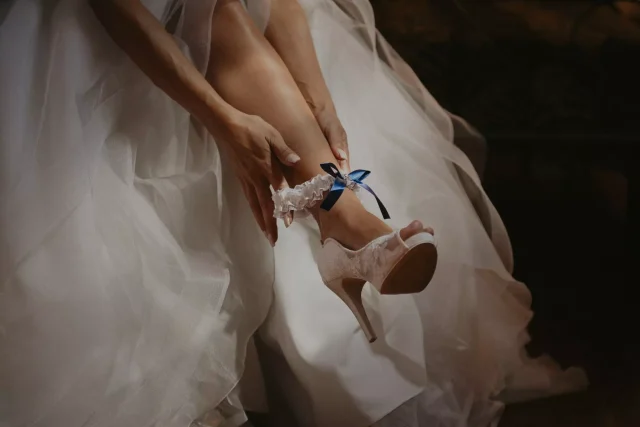
Speaking of the bride, it is also essential the presence of the garter, protagonist in the tradition of weddings already in the seventeenth century. Today the ritual requires the groom to take off his wife's garter and then throw it to the unmarried men present at the ceremony. Here too a whole series of rules for wearing it as tradition dictates: the garter, which must always be given as a gift and never purchased by the bride, is worn exclusively on the right leg, just above the knee.
Rites and traditions of the groom
The groom must not see the bride the day before the wedding and will only be able to admire her dress once she arrives at the altar. Simply put, no spoilers allowed.
Plus, once he leaves home on the morning of the big day, he'll never be able to go back. If he has forgotten something, it will not be his job to pick it up. Witness and mother of the groom will be ready to help him to prevent bad luck from preparing his ambush.
According to the rites and customs of marriage, the groom takes care of the bouquets. In fact, this will be the last gift from the boyfriend to the future partner and must be purchased and delivered with a note to the bride's house on the morning of the big day.
Another propitiatory rite has to do with entering the house after the wedding celebration. The husband will pick up the wife to prevent her from putting her feet on the ground. There is talk of a custom with very ancient origins and linked to fidelity.

Rites and traditions for wedding guests
But the tradition and customs regarding the outfit don't just have to do with the bride. In fact, even the guests should follow some precepts, capable of putting even the most savvy into a crisis. There are indeed a number of colors to avoid absolutely: primarily black and white, but also red and purple.
The guests are then involved in some rites that take place during the party, after the wedding celebration. Unmarried men participate in the garter toss, just as unmarried women compete for the bride's bouquet.
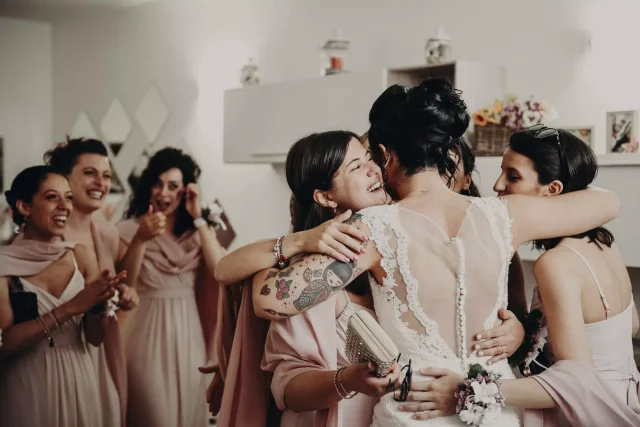
Some guests will have a very important and more specific task. The tradition of weddings in fact requires the presence of one or more bridesmaids who will accompany and morally support the bride during the ceremony, often also during the preparations. This rite comes from ancient Egypt where it was believed that evil spirits did not like brides. Thus, during the ritual, she made her friends dress like the bride to be able to sidetrack and hinder them.
Finally, a more goliardic aspect that must never be missing in a wedding. The beeps after the wedding celebration they are in fact a must and a traditional rite performed by the guests. Why honk? It is said that it was played after the ceremony by the relatives of the bride and groom to ward off evil spirits and their wrath. So, please, don't spare yourselves and honk your horn in the streets of the city.
Sugared almonds and favours, a question of numbers
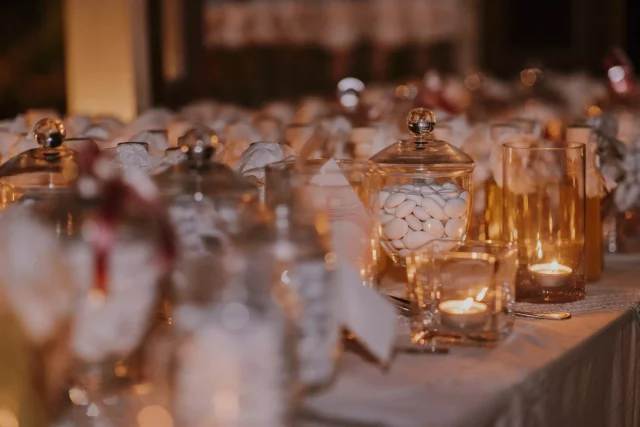
Let's move on to sugared almonds and favors. Not even these can escape propitiatory rites and customs.
The candy box, as we understand it today, was born in 1896 on the occasion of the wedding of the prince of Naples and future king of Italy, Vittorio Emanuele, with Elena of Montenegro. For the special occasion, the guests brought wedding favors, little bags or boxes containing sugared almonds (from the French Bon Bon, i.e. gluttony) as a symbol of prosperity and fecundity.
Today the concept of wedding favors has evolved and it is easy to find completely innovative and less traditional objects. But the bag with the sugared almonds is still omnipresent. Regardless of the flavors you choose, the sugared almonds must be in an odd number, to represent the indivisibility of the union, usually five to symbolize health, fertility, longevity, happiness and wealth, the ingredients that cannot be missing in married life.